Ice Age Cave Paintings Were Not Art. They Were Religion.
Cave paintings go back 40,000 years -- long before farming or temples. They were made in darkness, in the deepest parts of caves, for religious ceremonies. Here is what they tell us about what early humans believed.
The last chapter showed how religion drove the transition from hunting to farming. Three ancient sites -- Göbekli Tepe, Jericho, and Çatalhöyük -- all pointed to the same conclusion: people settled down to worship together, and farming followed.
But how far back does this religious impulse go? Much further than those sites.
Ice Age cave paintings go back 30,000 to 40,000 years. They were painted long before anyone built a temple or planted a crop. And they tell us something important: the need to make sense of the world is not a product of civilization. It is what made us human in the first place.
A Brief History of How We Got Everywhere
300,000 years ago, modern humans appeared in Africa. Then about 100,000 years ago, the world got much colder. Resources became scarce. That scarcity pushed us to move.
We spread into Europe, then Asia, then across the Bering Strait (frozen land at the time) into North America, South America, and from Asia down into Australia. We colonized the entire planet.
By 20,000 years ago, there were only about 1 million of us spread across the whole world. Along the way, we encountered other human species like the Neanderthals and interbred with them until we became the dominant human species.
This is the world of the cave paintings.
What the Cave Paintings Look Like
The most famous examples come from the Chauvet Cave in France (about 30,000 years old), La Coa Cave (about 20,000 years ago), and Altamira in Spain (about 34,000 BCE).
 ExpandLascaux cave paintings showing bulls and horses -- painted 17,000 years ago in France
 ExpandAltamira cave bison painting -- one of the oldest and most detailed animal paintings ever found
They are full of animals. Bison. Rhinoceros. Lions. Horses. All moving, all alive, often overlapping each other as if nature itself is one connected image.
When the artist Pablo Picasso was taken into one of these caves, he said: "We have learned nothing in 10,000 years." The artistry was that good. Humans have not improved as artists in tens of thousands of years.
The paints were simple: red from ochre (a type of clay) and black from charcoal. Lighting came from burning animal fat. The caves were dark, cold, and hard to breathe in. People went in anyway and spent days painting.
 ExpandFont-de-Gaume cave in France -- one of the last caves where original Ice Age paintings are still visible to the public
Why They Painted Them
The biggest clue is where the paintings were found inside the caves.
Not near the entrance. Not in any random spot. Always in the section of the cave where the acoustics were best -- where sound carried most clearly and echoed most strongly. Musical instruments, including flutes, were found in these same areas.
This tells us these were not art galleries. They were ritual spaces. Hunter-gatherers would travel to these caves for religious festivals. There would be music. There would be dancing. The paintings on the walls were the backdrop to all of it.
The paintings were not made to be admired. They were made to be part of worship.
What They Believed
No one wrote anything down. So we cannot know for certain. But we can make a reasonable guess by asking: if you had no science, no biology class, no explanation for anything, what would amaze you about the world?
Childbirth. A new life appearing from nowhere. If you have never studied biology, you cannot explain it. It feels like a miracle -- something from another world entering this one.
The stars. At night with no light pollution, the sky is full of them. What are they? Other worlds? Souls of the dead?
Healing. Someone is sick and then recovers. How? One explanation: the body and soul are sometimes out of alignment. When they come back together, healing happens. Chinese traditional medicine still uses a version of this idea today.
The vastness of nature. Animals, trees, mountains, rivers. All of it feels alive. All of it feels connected.
The Theory They Probably Built
Take all of those observations and try to build one explanation for how the world works.
The stars suggest other worlds and powers exist. People come through the mother's womb -- from darkness into light. When they die, they return to darkness, back into the earth through burial.
The womb is a portal. Souls enter our world through it. Burial sends them back.
And what in nature looks most like a womb? A cave. A dark tunnel leading somewhere deeper.
So the cave is a portal too. Animals come from the spirit world just as humans do. When you paint an animal on the wall of a cave, you are calling it back. You are summoning it.
This is why the paintings are in caves. The ceremony inside was not about looking at pictures. It was about bringing the animals back after killing them -- returning their souls to the spirit world so the balance of nature could be maintained.
Everything Is Connected: The Mother Goddess
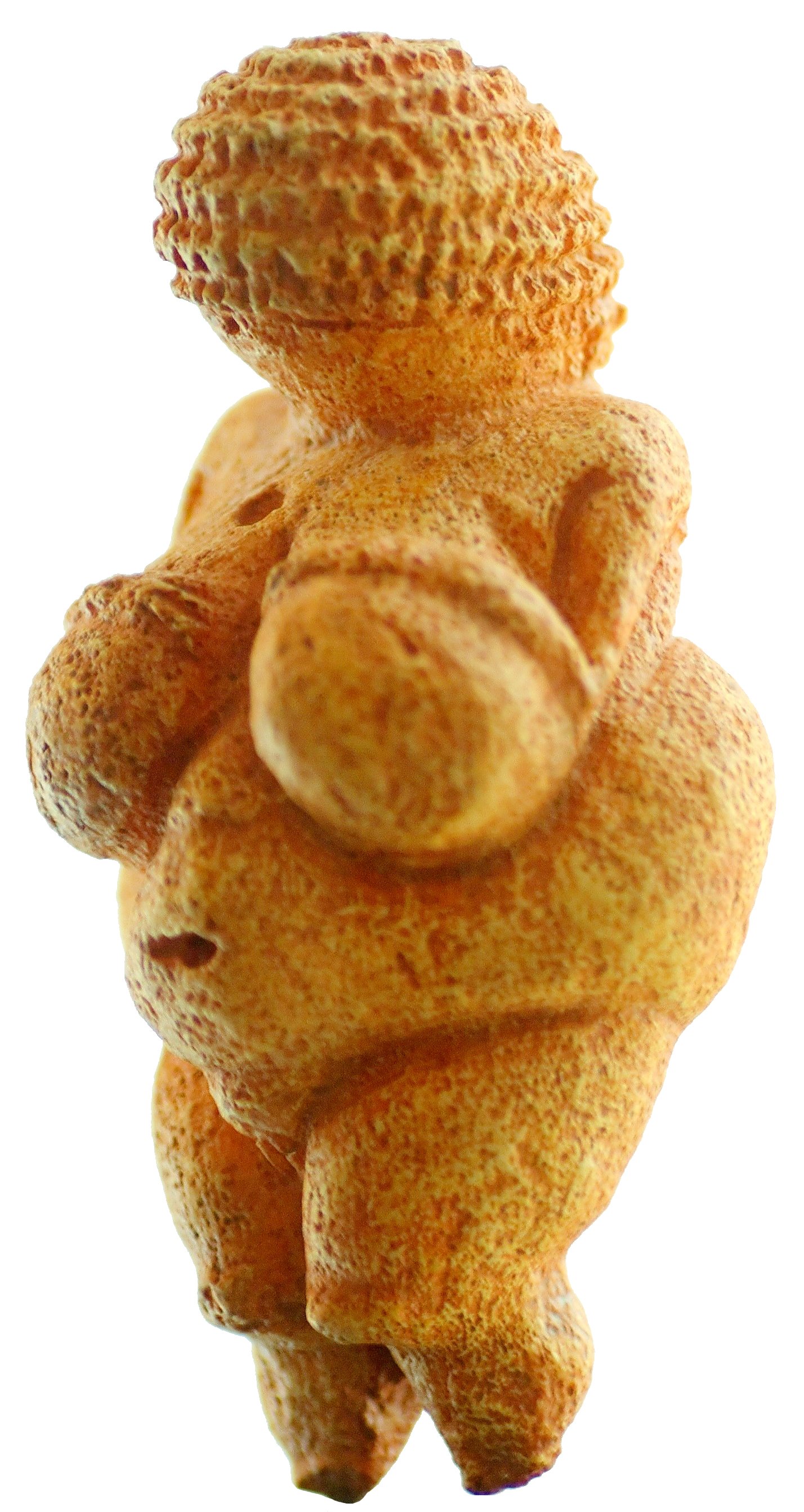 ExpandVenus of Willendorf -- a 25,000-year-old figurine of the Mother Goddess, found in Austria
At the center of all of this is one idea: the Mother Goddess. One force that gives life to everything.
If the Mother Goddess gives life to trees, animals, and humans equally, then all living things are equal. We are all her children. We all have souls.
So what gives us permission to kill and eat other animals?
Mother Nature has a plan. Every living thing has a function in maintaining balance. If we do not hunt, other animals overpopulate and the balance breaks. So we are allowed to kill -- but only with respect, gratitude, and the intention of restoring what we take.
Kill an animal. Ask for its forgiveness. Bring its soul back through ceremony. Keep the balance.
The Name for This Religion: Animism
This belief system has a name: animism. It is probably the oldest religion in the world.
Animism says every living thing -- a tree, a mosquito, a person -- has a soul. Everything is connected. We must keep balance and harmony.
Versions of animism still exist today in indigenous communities across North America, South America, and Australia. Buddhism carries versions of it too.
And modern science has started to confirm parts of it. We recently discovered that trees communicate with each other through fungi networks in the soil. If one tree lacks nutrients, nearby trees send resources through the network. If one is attacked by insects, it signals the others to prepare. Mother trees even recognize their own seedlings and prioritize them.
The forest is one large connected organism. Hunter-gatherers who lived inside nature felt this without instruments. They just knew.
The next post covers who practiced this religion, how they accessed the spirit world, and what the symbols in the cave paintings actually mean.
Further Reading and Watching
- Video: The Agricultural Revolution -- Crash Course World History #1 -- great context for the world these cave painters lived in
- Book: The Forest People by Colin Turnbull -- a close account of people still living close to this worldview
- Wikipedia: Cave painting · Lascaux · Animism · Venus figurines
Keep reading